
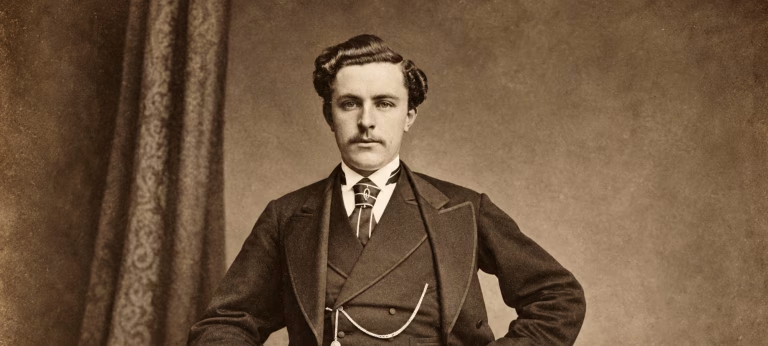
Young Tom Morris lived only 24 years, yet he achieved enough to secure a permanent place in golf history. He became The Open's youngest Champion at 17 and went on to win the Championship four times in succession.
In this article, we follow the career behind those records, the golf that made him exceptional, his bond with Old Tom, and the Scottish courses that still carry his story.
Key Takeaways
- Young Tom Morris became golf's youngest Open Champion at 17 after growing up between St Andrews and Prestwick.
- Before winning The Open, he had already proven himself against experienced Scottish professionals, including a tournament victory at Carnoustie.
- Young Tom won four consecutive Open Championships between 1868 and 1872, including three straight titles that secured the Challenge Belt.
- Old Tom first taught his son, then competed against him before the pair became respected partners in high-profile challenge matches.
- His final competitive years remained strong before a deeply difficult period in 1875, and his own life was cut short at just 24.
- Beyond records, Young Tom became one of golf's earliest sporting celebrities, drawing large crowds and wider press attention.
- Prestwick, St Andrews, Carnoustie, Leven, Musselburgh, and North Berwick still mark important stages of Young Tom's remarkable story.
Golf's Youngest Open Champion
Thomas Morris Jr, better known as Young Tom Morris, was born in St Andrews on 20 April 1851. At 17 years and 156 days, he became the youngest winner in Open Championship history, a record still standing today.
He spent most of his childhood in Prestwick, where the Morris family moved while he was still an infant. Old Tom had accepted work there as club professional and greenkeeper, bringing his young family to Ayrshire just as Prestwick was developing into one of the most important settings in early competitive golf.
The move widened Young Tom's world beyond the links. He attended Ayr Academy until his early teens, combining a formal education with a childhood already shaped by golf.
IMAGE HERE
Golf itself was part of everyday life at Prestwick. Young Tom learned directly on the links rather than entering through caddying or clubmaking, routes commonly followed by aspiring players of the period. He grew up with the game as a constant presence, not simply a future occupation.
He was growing up alongside The Open itself. The championship began at Prestwick in 1860, when Young Tom was nine, so organised professional competition belonged to the world around him rather than to an established past.
The Morris family later returned to St Andrews before Young Tom's greatest competitive years. That brought him back to his birthplace while preserving the Prestwick influence that had shaped his childhood.
Those surroundings gave him access and familiarity, but reputation still had to be earned against experienced professionals. Before the championship victories that would define his name, Young Tom first had to show that his ability could stand up in serious competition.
Old Tom as Teacher, Rival, and Partner
Old Tom Morris shaped the professional world in which his son first learned the game. At Prestwick, Young Tom grew up beside a father who was already a leading player and greenkeeper, giving him a close view of professional golf.
When the family returned to St Andrews in 1864, the relationship began to change. Young Tom was no longer simply the professional's son watching from the edges of the links. His reputation was growing, and before long father and son were appearing together in serious competition.
That same year, Young Tom beat his father for the first time in a friendly match at St Andrews. He was only 13, while Old Tom was the reigning Champion Golfer, an early sign that the balance between them was beginning to shift.
Old Tom remained one of Scotland's strongest competitors, so there was nothing ceremonial about playing against him. As Young Tom improved, family ties sat beside genuine sporting rivalry. They could walk the same links as father and son while each still had his own result and reputation to protect.
IMAGE HERE
Their relationship soon developed into a working partnership through challenge matches. Father and son took on other leading professionals for agreed stakes, an important form of competitive golf before a regular tournament circuit had fully developed.
The Park family provided some of their strongest opposition. Willie Park Sr had been Old Tom's great rival for years, while his brother Mungo also became an Open Champion. Matches involving the Morrises and Parks carried the weight of two prominent golfing families whose reputations were built through direct competition.
For Old Tom, partnering his son also reversed the usual sporting order. The experienced professional who had spent years building his own reputation could now rely on Young Tom as a genuine equal when they played together.
Young Tom moved through several roles beside his father without losing the family connection between them. By the early 1870s, he had become an opponent Old Tom had to respect and a partner he could trust, while his own golfing identity was becoming unmistakably separate.
Proving Himself Among Scotland's Best
Young Tom's first recorded public test came at Perth in April 1864, shortly before his thirteenth birthday. Unable to enter the main contests, he instead played local youngster Willie Greig and won before a large gallery gathered around the course.
The Perth match carried more weight than a junior exhibition might suggest. It placed him before spectators beyond Prestwick and St Andrews, while contemporary reports remarked on the maturity of his golf. Even at that age, his control and composure made the contest worth following in its own right.
A year later, aged 14, he entered The Open at Prestwick for the first time. He did not complete the championship, but appearing in the field placed him alongside professionals whose reputations were already established across Scottish golf.
IMAGE HERE
His return in 1866 gave a clearer measure of progress. Young Tom finished ninth, 18 strokes behind Willie Park Sr, gaining experience against a field led by men already proven through championship golf and established competition around Scotland.
The improvement continued in 1867. Still only 16, he finished fourth at The Open, moving much closer to the leaders and showing that his place among Scotland's professionals was increasingly being earned through results alone.
Carnoustie provided the clearest evidence later that year. Young Tom tied for first in a major professional tournament before defeating Willie Park Sr and Bob Andrew in a play-off. For a 16-year-old to overcome seasoned competitors of that standing made his growing reputation hard to dismiss.
Willie Park Sr was already one of the outstanding golfers of the era, so the Carnoustie result carried particular weight. Young Tom had shown he could produce winning golf when experienced professionals were competing seriously.
By the end of 1867, his progress had formed a convincing sequence: public promise at Perth, championship experience at Prestwick, a fourth-place Open finish, then victory over leading professionals at Carnoustie. His reputation now rested on performances that golfers across Scotland could judge directly.
Young Tom entered the next stage of his career with evidence behind the reputation, having tested himself repeatedly against Scotland's leading professionals and shown that age was no barrier to competing on their terms.
Four Open Championships in Five Years
Young Tom entered 1868 already well established among Scotland's strongest professionals. What followed was exceptional: he won every Open Championship staged from 1868 through 1872, beginning a four-title sequence while he was still only 17.
These early Opens looked very different from the championship golfers know today. Prestwick remained a 12-hole course, with the title settled over three rounds and 36 holes on the same day. In that compressed format, there was little room to recover from a costly stretch of golf.
1868: Champion at Just 17
The 1868 Open was Young Tom's fourth Championship appearance. At 17 years and 156 days, he opened with 51 around Prestwick's 12 holes, setting the lowest round yet recorded in The Open and taking an immediate lead.
IMAGE HERE
His 51 left Bob Andrew two strokes behind, but the advantage disappeared during the second round. Young Tom returned a 54, while Old Tom Morris and Willie Park Sr each shot 50, jointly lowering the Open round record and leaving his father one stroke ahead.
Young Tom responded in the final round with a 49, lowering the record again. Four threes in five holes from the seventh gave his closing stretch real force and turned a one-stroke deficit into control of the Championship.
He still chose an aggressive route at the final hole despite holding enough strokes in hand, going for the green in two before making four. His total of 154 beat Old Tom by three and lowered Andrew Strath's previous Championship aggregate record by eight strokes.
Bob Andrew finished third on 159, with Willie Park Sr fourth on 162. Young Tom's winning total came against a field containing the reigning Champion and several established professionals, while also setting a new benchmark for the 36-hole Championship.
1869: Defending the Championship
Young Tom returned to Prestwick in 1869 as defending Champion, aged 18. An opening 50 immediately put him ahead again, although the defining moment of that round came with a single stroke at the eighth hole.
Known as the Station Hole, the eighth measured 166 yards and played over the Alps hill to a blind green protected by the Sahara Bunker. Young Tom struck his tee shot onto the putting surface, where it rolled towards the cup and dropped for The Open's first recorded hole-in-one.
That ace contributed to a three-stroke first-round lead over Davie Strath and Bob Kirk. Because the green could not be seen from the tee, Morris had to wait for the reaction around the hole to know what his shot had done.
He widened the advantage with a second-round 55, taking a four-stroke lead into the final 12 holes. A closing 52 completed a total of 157, while Bob Kirk finished second on 168. The resulting 11-stroke margin made the defence emphatic despite the difficult wind.
Davie Strath placed third on 169, while Old Tom finished sixth on 176. Young Tom was the only competitor to record 55 or better in every round as stronger wind drove scoring higher across much of the field.
IMAGE HERE
1870: Winning the Challenge Belt
Young Tom returned to Prestwick in 1870 chasing a third consecutive Open title, with the Challenge Belt itself at stake. Another victory would satisfy the Championship's original rule and make the belt his property for good.
His opening round immediately separated him from the field. At the 578-yard first, he holed a blind approach of about 200 yards for three, then completed Prestwick's 12 holes in 47, lowering his own course record by two strokes and taking a five-stroke lead into the second round.
A second-round 51 preserved the advantage. Young Tom added another 51 in the final round for 149, a total never bettered during the years when The Open was decided over 36 holes on Prestwick's original 12-hole course.
Bob Kirk and Davie Strath shared second place on 161, with Old Tom one stroke further back. Young Tom's winning margin was 12 strokes, completing three successive Championships in which he had increasingly separated himself from many of Scotland's established professionals across the same demanding links.
The victory transferred the Challenge Belt permanently to Young Tom under the rules written for the inaugural Open. Prestwick no longer had its Championship prize to present, creating a problem for the following season ahead.
1872: Four Victories in a Row
There was no Open Championship in 1871. Young Tom's third straight victory had made the Challenge Belt his property, and with no replacement trophy ready, the organisers had nothing to award a new Champion.
Discussions about reviving the Championship began at Prestwick in 1871, but agreement took time. In September 1872, Prestwick, the Royal and Ancient Golf Club at St Andrews, and the Honourable Company of Edinburgh Golfers agreed to share responsibility for staging The Open and funding a new trophy.
IMAGE HERE
The arrangement came too late for the new silver Claret Jug to be ready. A medal was prepared instead, and the 1872 Championship was announced at only two days' notice, leaving a field of just eight players at Prestwick.
Davie Strath led after the first two rounds. His scores of 56 and 52 gave him a five-stroke advantage over Young Tom, who had opened with 57 and 56. For the first time in this four-title run, Morris entered the final round needing to chase down a clear leader.
Strath faltered in the closing round, eventually returning 61, while Young Tom produced a steadier 53. That gave Morris a total of 166 and a three-stroke victory, with amateur William Doleman taking third place on 177.
Young Tom received the winner's medal rather than the unfinished Claret Jug. When the trophy was completed, his name was engraved first for the 1872 Championship, while Tom Kidd became the first Champion actually presented with the Jug after winning at St Andrews in 1873.
The Final Years of Young Tom Morris
After his fourth Open victory in 1872, Young Tom remained a leading contender. His final Open came at Musselburgh in 1874. Young Tom began eight strokes behind leader Mungo Park after the opening 18 holes, then mounted a recovery. A missed short putt at the penultimate hole, followed by two dropped shots at the last, left him two strokes short of the title.
Young Tom married Margaret Drinnen in 1874. His competitive life in Scotland continued through challenge matches and other appearances, but marriage gave his final years a personal dimension separate from the championship results that had already made his name.
IMAGE HERE
In September 1875, Young Tom and his father were playing Willie and Mungo Park in a challenge match at North Berwick when word arrived that Margaret was experiencing serious difficulties in labour. The Morrises immediately tried to make their way back across the Forth to St Andrews.
Margaret and the baby passed away before Young Tom could return to St Andrews. He and Old Tom then missed the 1875 Open at Prestwick, held only days later, as the family remained at home during a period of private mourning.
Young Tom did return to golf afterwards, although the months that followed were understandably difficult. On Christmas Eve, he spent time with his parents before retiring for the night. He passed away the following morning, bringing an extraordinary life to a close far too early.
The belief that Young Tom died of a broken heart later became part of golf folklore. His recorded cause of death was a pulmonary haemorrhage linked to a ruptured artery in his lung. He passed away on Christmas Day 1875, aged 24.
A Legacy Beyond Championships and Records
After many years, Young Tom's championship record still stands apart. At 17 years and 156 days, he remains the youngest Open Champion, while no golfer has matched his run of four consecutive victories across every Open staged between 1868 and 1872.
His age makes the wider record even more unusual. Young Tom first competed in The Open at 14 years and 147 days, still the youngest player recorded in the Championship, then claimed four of the five youngest-winning places in its history before reaching his twenty-second birthday.
His reputation spread well beyond championship week. Challenge matches with Old Tom drew thousands of spectators from across Scotland, while exhibition appearances in England carried Young Tom's name to audiences beyond the established Scottish golfing centres.
That attention reached the national press as well. During the 1870s, major London newspapers and magazines sent special correspondents to Scotland to report on his challenge matches, showing that interest in Young Tom had moved beyond local galleries and into a much wider sporting conversation around professional golf.
IMAGE HERE
Professional golf was still forming its public identity during his career. With no regular tour resembling the modern game, challenge matches and exhibitions mattered greatly, giving leading players opportunities to compete for stakes while attracting paying spectators.
Young Tom became one of golf's earliest genuine sporting celebrities within that setting. Crowds followed the player as much as the contest, and his youth made his success especially compelling. A professional golfer could command attention beyond a single club, local match, or championship field.
His rise also represented a generational change. Old Tom built his standing over decades, while his son showed how rapidly exceptional results could turn a teenage professional into a nationally recognised sporting figure in Victorian Britain.
Young Tom's brief career gives those achievements even greater historical weight. He passed away at 24, yet his youngest-winner record and four-title sequence remain intact more than 150 years later, alongside his place among the early professionals who broadened golf's appeal to the watching public.
The Courses That Carry His Legacy
The six courses tied to Young Tom Morris mark different stages of his short career. Some hosted victories, while others witnessed its closing years. Their layouts have changed since the nineteenth century, but the historical connections remain clear.
Prestwick and St Andrews
IMAGE HERE
Prestwick Golf Club carries the deepest competitive connection. Young Tom spent much of his childhood beside these links, then won all four of his Open Championships here in 1868, 1869, 1870, and 1872. No other course is as closely tied to the achievements that established his place in golf history.
Those Championships were played over Prestwick's original 12-hole layout, not today's course. Six greens from Old Tom's early design remain in use, preserving part of the ground on which Young Tom built his Open record.
St Andrews Links (Old Course) formed the other great geographical anchor in Young Tom's life. Born in St Andrews, he returned with his family in the 1860s and later competed when The Open came to the Old Course for the first time in 1873.
That Championship did not bring a fifth title. Young Tom finished third, four strokes behind Tom Kidd, making the Old Course part of his competitive story as well as the links of his home town.
Carnoustie and Leven
IMAGE HERE
Carnoustie Golf Links (Championship Course) is tied to one of Young Tom's earliest major professional successes. At only 16, he won the 1867 Open Professional Tournament at Carnoustie against leading Scottish golfers, proving that his reputation could withstand serious competition against experienced professionals.
The present Championship Course is not the exact layout he encountered. Carnoustie changed greatly in later decades, including major work by James Braid in 1926, so the Young Tom connection belongs to the historic links rather than every feature played today.
Leven Links entered Young Tom's story in 1868, when the course was extended to 18 holes. A 36-hole exhibition match marked the opening, and the 17-year-old Open Champion won with 170 strokes, placing him directly within an important moment in Leven's golfing history.
The links later changed as Leven and Lundin developed separately, but that opening exhibition remains part of the course's recorded past. Young Tom's victory gives today's Leven Links a direct competitive connection to his first season as Open Champion.
Musselburgh and North Berwick
IMAGE HERE
Musselburgh Links (Old Course) staged Young Tom's final Open Championship appearance in 1874. Over four loops of the nine-hole course, he recovered from an eight-stroke halfway deficit and became Mungo Park's closest challenger before finishing two strokes behind.
It was also Musselburgh's first Open. Young Tom's runner-up finish sits within a wider milestone for the venue, showing that he remained a serious Championship contender as The Open began moving among Scotland's historic links.
North Berwick Golf Club (West Links) holds a deeply personal place in Young Tom's story. It was here, in September 1875, that he and Old Tom were playing Willie and Mungo Park when news arrived of serious complications during Margaret's childbirth in St Andrews.
The West Links then had nine holes, having expanded in 1868 and not reaching 18 until 1877. Young Tom knew an earlier version of the course, but the same links remain tied to the closing months of his life.
Bring the History to Life
Young Tom Morris packed an extraordinary amount of golf into a life that was cut short at 24. His records still command attention, while his talent drew crowds and made him one of professional golf's earliest major sporting figures.
For golfers visiting Scotland today, that history remains within reach. Prestwick, St Andrews, Carnoustie, Leven, Musselburgh, and North Berwick each offer a direct connection to different chapters of his remarkable career.
His life was short, but the footsteps he left across Scottish golf have never disappeared.
If a new golf experience is on your mind, start the conversation with Kinfern. We can develop your ideas into a considered itinerary, bringing together the golf, accommodation, transfers, and local details into one well-planned experience.